Publications
Books
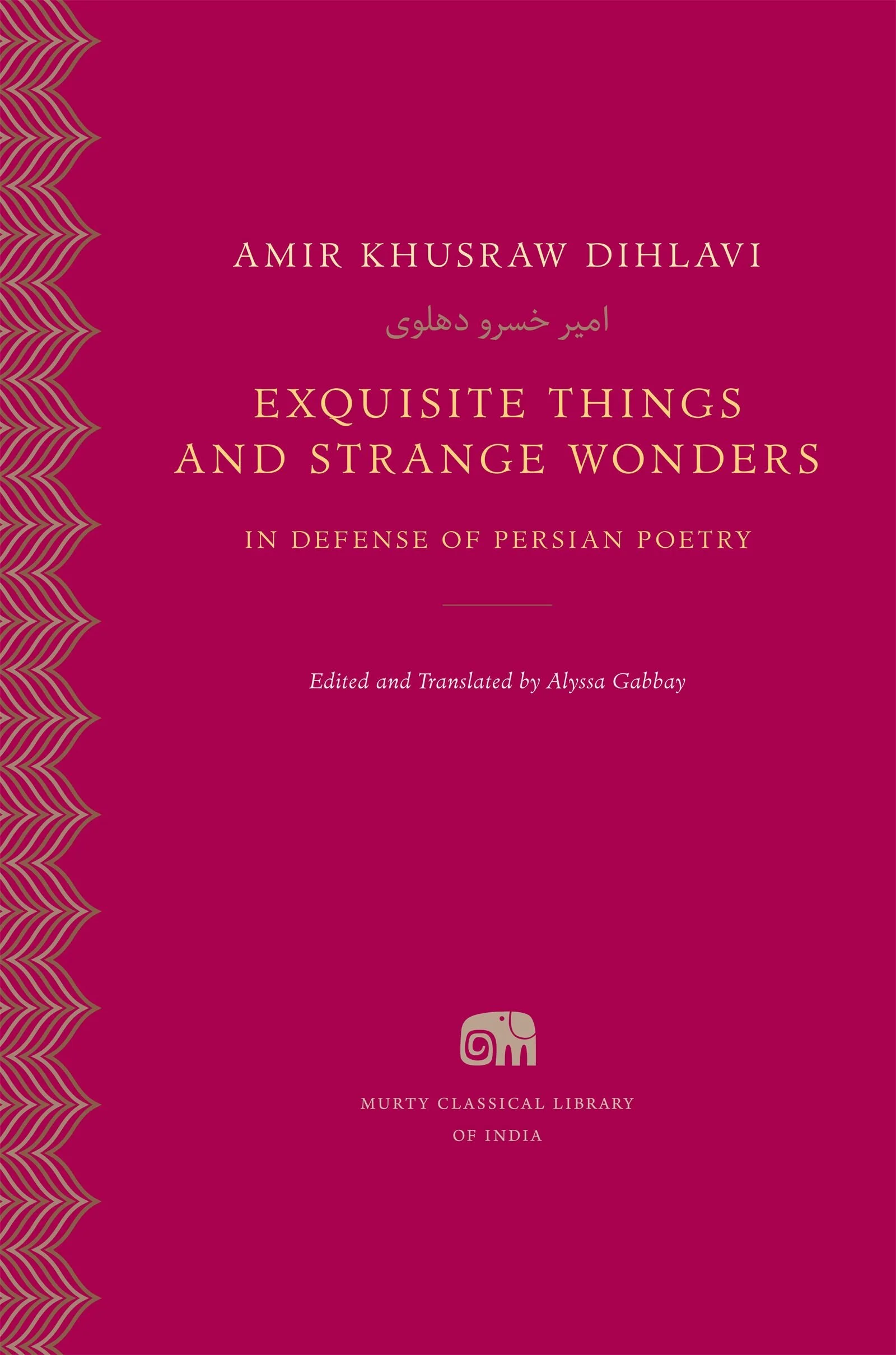
Exquisite Things and Strange Wonders: In Defense of Persian Poetry
Amir Khusraw Dihlavi; edited and translated by Alyssa Gabbay
A defense of poetry from a towering figure of the medieval Persianate world.
Written in 1294 as the introduction to a book of poetry, the Dībācha-yi dīvān-i ghurrat al-kamāl became a lauded work in its own right. Its author, Amir Khusraw Dihlavi (1253–1325), was a poet, historian, courtier, Sufi, and musician whose influence still resonates. In this extraordinary text, he defends poetry against its critics, especially religious scholars, while offering a bold system for understanding its forms and for mastering the art. Blending manifesto and autobiography, Khusraw recounts personal struggles and triumphs in a voice by turns aggrieved, proud, and humble yet always commanding.
More than a defense of poetry, the work makes audacious claims about its cultural power and about the central place of Persian poets in India. One of the earliest examples of literary criticism in Persian, it challenges assumptions about poetry, religion, and authority while opening a window onto the world of the Delhi Sultanate. Presented here in a new English translation with the Persian text in the Naskh script, Exquisite Things and Strange Wonders offers readers a vivid portrait of a poet who helped define the literary and intellectual landscape of his time.
For more information about this publication please visit the Harvard University website.

Islamic Tolerance: Amir Khusraw and Pluralism (Routledge, 2010)
Although pluralism and religious tolerance are most often associated today with Western Enlightenment thinkers, the roots of these ideologies stretch back to non-Western and pre-modern societies, including many under Muslim rule. This book explores the development of pluralism in Islam in South Asia through the work of the poet, historian and musician Amir Khusraw and sheds new light on how Islam developed its own culture of tolerance.
Countering stereotypes of Islam as intrinsically intolerant, the book provides a better understanding of how rhetorics of pluralism develop, which may aid in identifying and encouraging such discourses in the present. Khusraw, a practicing Muslim who showed great affection toward Hindus and used much indigenous imagery in his poetry, is an ideal figure through whom to explore these issues. Addressing issues of ethnicity, religion and gender in the early medieval period, Alyssa Gabbay demonstrates the pre-modern precedents for pluralism, conveying the broad sweep of Perso-Islamicate culture and the profound transformations it underwent in medieval South Asia.
Accurately depicting the paradoxicality and jaggedness involved in the development of its composite culture, this book has great relevance to scholars and students of Islam in South Asia, gender, religious pluralism, and Persian literature.
“An important landmark in scholarship on classical Persian literature and medieval South Asian literature … meticulously researched and lucidly written.”
–Sunil Sharma, Boston University.
To order Islamic Tolerance visit the Routledge website.
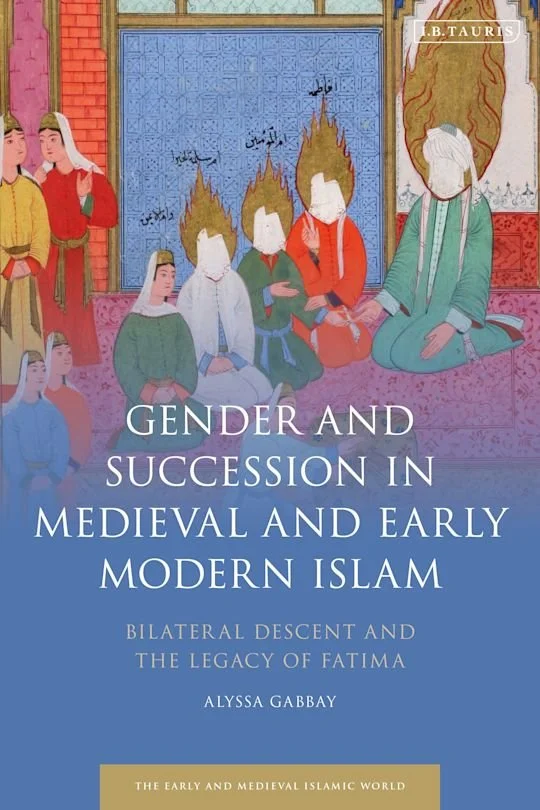
Gender and Succession in Medieval and Early Modern Islam: Bilateral Descent and the Legacy of Fatima
While most pre-modern Islamic societies were patrilineal, many did recognize the ability of a daughter to perpetuate her birth lineage -- a matter of great significance for the status of women. In Gender and Succession in Medieval and Early Modern Islam (I.B. Tauris/Bloomsbury, 2020), Alyssa Gabbay draws on collections of hadith, Qur’an commentaries, historical chronicles, poems and other sources to examine episodes in pre-modern Islamic history in which individuals or societies recognized descent from both males and females. She carries out this examination primarily through the lens of Fatima, the daughter of the Prophet Muhammad, as depicted in Sunni and Shi‘i texts. Fatima rarely appears as a feminist icon in Western scholarship. Yet as this book demonstrates, her example constitutes a striking precedent for acknowledging bilateral descent in Sunni and Shi‘i societies, with all of its ramifications for female inheritance, succession, and identity. Covering a broad geographical and chronological swath, this book lays bare alternative perspectives to patriarchal narratives. In so doing, it builds upon a tradition of studies seeking to dispel monolithic understandings of Islam and gender.
“… will be seen as a major contribution to the discussion of gendered inheritance in Islam, and the mechanisms whereby Muslim female authority was safeguarded and passed on to new generations.”
-Dominic Brookshaw, University of Oxford
“A layered and nuanced picture of gendered relations in the Islamic past … supported by rigorous research and written in accessible language.”
-Religiology
“An important contribution to the field of gender and Islam. Gabbay’s work brings together a range of scholarship related to Shi’i Hadith, Fatima, Islamic inheritance, and gender studies in a way that is both engaging and illuminating.”
-Shi’i Studies Review
For more information about this publication visit the book description on the Bloomsbury Website.
Click here to listen to an interview with Alyssa Gabbay about the book.
Journal Articles
“‘The Earth My Throne, The Heavens My Crown’: Siyavash as Supranational Hero in Ferdowsi’s Shahnama.”Journal of Persianate Studies 15, no. 2 (2022/3), pp. 157–173.
“Splitting Hairs and Trimming Tresses: Translating Amīr Khusraw’s Persian Locks into An American ‘Do.” In Middle Eastern Literatures 19, no. 3 (2016), pp. 316–324.
“In Reality a Man: Sultan Iltutmish, His Daughter, Raziya, and Gender Ambiguity in Thirteenth-Century Northern India.”In “Fathers and Daughters in Islam: Spiritual Inheritance and Succession Politics,” ed. Alyssa Gabbay and Julia Clancy-Smith. Special issue, Journal of Persianate Studies 4, no. 1 (2011), pp. 45–63.
“Fathers and Daughters in Islam: Spiritual Inheritance and Succession Politics.” Co-editor (with Julia Clancy-Smith), foreword, and article. Special issue, Journal of Persianate Studies 4, no. 1 (2011).
“Love Gone Wrong, Then Right Again: Male/Female Dynamics in the Bahrām Gūr-Slave Girl Story.” In “Love and Desire in Pre-Modern Persian Poetry and Prose,” ed. Dominic Brookshaw. Special Issue, Iranian Studies 42, no. 5 (2009), pp. 677–692.
Book Chapters
“Heiress to the Prophet: Fatimah as Inheritor of Her Father’s Legacy.” In Female Religious Authority in Shi‘i Islam: Past and Present, ed. Mirjam Kuenkler and Devin Stewart. Edinburgh: Edinburgh University Press/New York: Oxford University Press, 2021.
“Mothers, Liver-Eaters, and Matrilineal Descent: Hint bint ‘Utba, Mu‘āwiya, and Nasab (Filiation) in Early Islam.” In Relations of Power: Women’s Networks in the Middle Ages, ed. Emma O’Loughlin Bérat, Rebecca Hardie and Irina Dumitrescu. Bonn: University of Bonn, 2021.
“Establishment of Centers of Indo-Persian Court Poetry.” In A History of Persian Literature, ed. Ehsan Yarshater et al., vol. 9: Persian Literature from Outside Iran: The Indian Subcontinent, Anatolia, Central Asia, and in Judeo-Persian. New York: I.B. Tauris, 2018.
“Rebels, Virtuous Adorers and Successors: The Agentic Daughters of the Shahnama.” In Shahnama Studies III:The Reception of Firdausi’s Shahnama, ed. Charles Melville and Gabrielle van den Berg, 292–313. Leiden: Brill, 2018.
‘In Praise of One of the Deeply Learned Ulama’: A Mysterious Poem by Qājār Court Poet Mīrzā Habīb Allāh Shīrāzī Qā’ānī.” In The Necklace of the Pleiades, ed. Franklin Lewis and Sunil Sharma, 131–48. Amsterdam and West Lafayette, IN: Rozenberg Publishers and Purdue University Press, 2007.
For a full list of publications please download Alyssa Gabbay’s C.V.